The Intelligence Layer
How to build a marketing system that grows itself

Most marketing organisations are running two businesses that don’t talk to each other.
On one side: a brand team protecting identity, narrative, and long-term equity. On the other: a performance team optimising clicks, CPAs, and conversion rates. Both doing serious work. Both measuring different things. Both, in isolation, leaving serious growth on the table.
The brands winning right now haven’t chosen sides.
They’ve built the thing that sits between.
I call it The Intelligence Layer. And if you’re not building it, you’re subsidising the brands that are.
Why brand and performance need each other, badly!
Here’s the uncomfortable truth about pure-play performance marketing: it works brilliantly, right up until it doesn’t. You optimise toward the cheapest acquisition, compress your messaging to what converts today, and slowly hollow out the very brand equity that made people convertible in the first place.
You’re mining an asset you’re no longer building.
Pure brand without performance is its own kind of waste. You build emotional resonance with people who never become customers. Beautiful work. Nobody measures it. You spend without learning.
The companies that crack growth aren’t choosing between the two. The brand system sets the emotional frame; performance marketing fires into it. Every piece of data from performance informs how the brand shows up next. It’s a loop, not a funnel. And loops compound.
Introducing the Growth Loop
Every customer interaction maps across five connected stages. Not as a linear pipeline, but as a system. Miss one and the whole thing leaks.
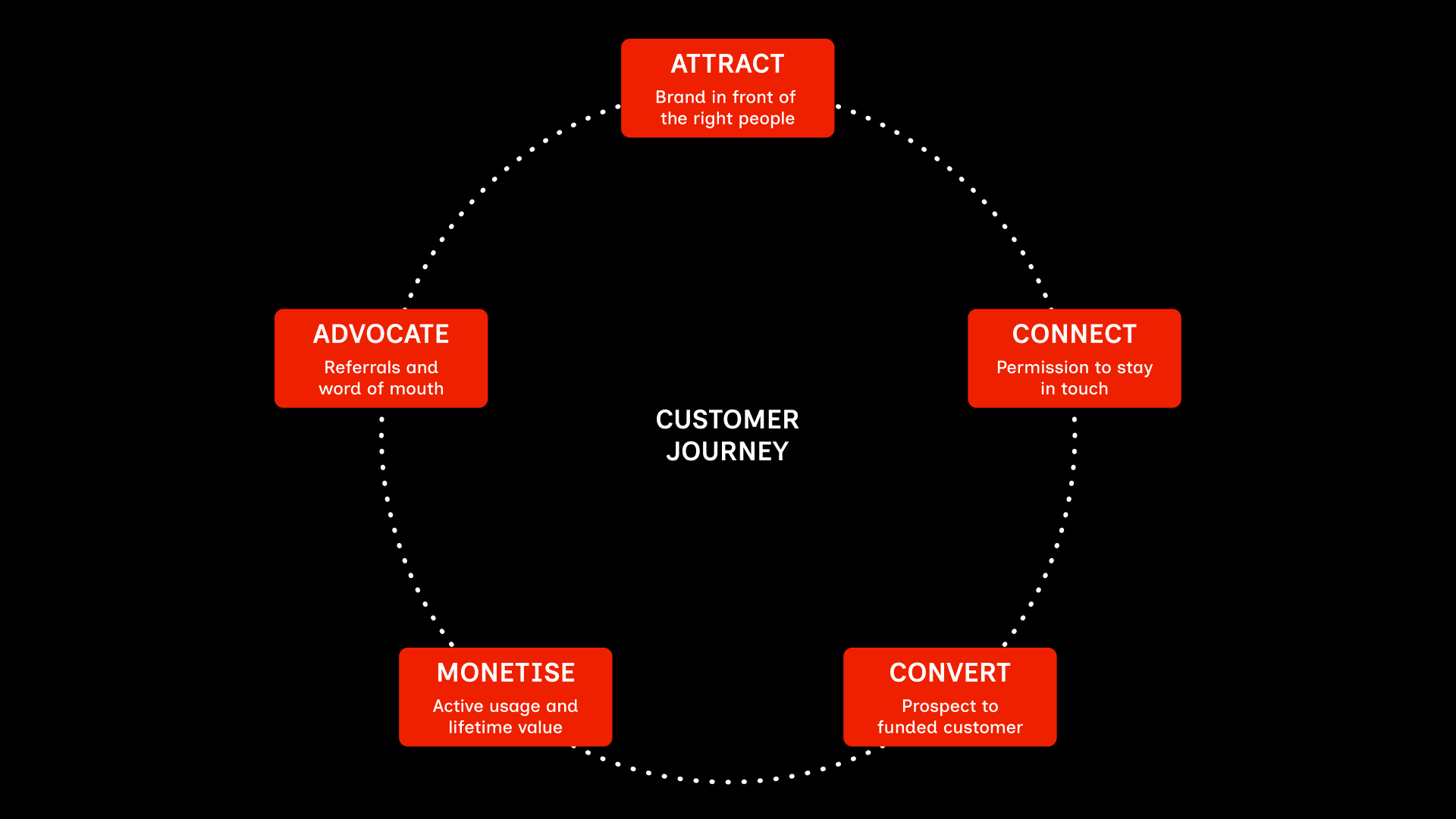
The Growth Loop: Five stages, one compounding system – James Collier
Attract: Getting your brand in front of the right people, not just any people. This is where brand does its heaviest lifting: distinctiveness, positioning, category presence.
Connect: Earning the right to stay in touch. Permission-based. Trust-dependent. The quality of connection here determines the efficiency of everything downstream.
Convert: Moving a prospect to a funded customer. Where performance marketing earns its keep: the right message, the right moment, the right offer.
Monetise: Active usage, product depth, lifetime value. Most organisations underinvest here. Your happiest customers are your cheapest acquisition channel — if you build for it.
Advocate: Referrals, word of mouth, organic reach. The stage that turns your growth loop into a compounding system. When it works, Attract gets cheaper every quarter.
The loop matters more than any individual stage. A conversion rate problem is sometimes actually a connection problem. An advocacy failure is often a monetisation failure. You can’t optimise one stage without understanding its relationship to the others.
The Intelligence Layer: what sits between
Here’s where most frameworks stop, and where most organisations stall.
You can understand the loop conceptually and still run brand and performance as separate functions, measuring different things, celebrating different wins. Understanding the loop isn’t the same as building it.
What closes the gap is data. But not data sitting in dashboards nobody connects to strategy. The Intelligence Layer is the operating infrastructure that makes signals flow both ways:
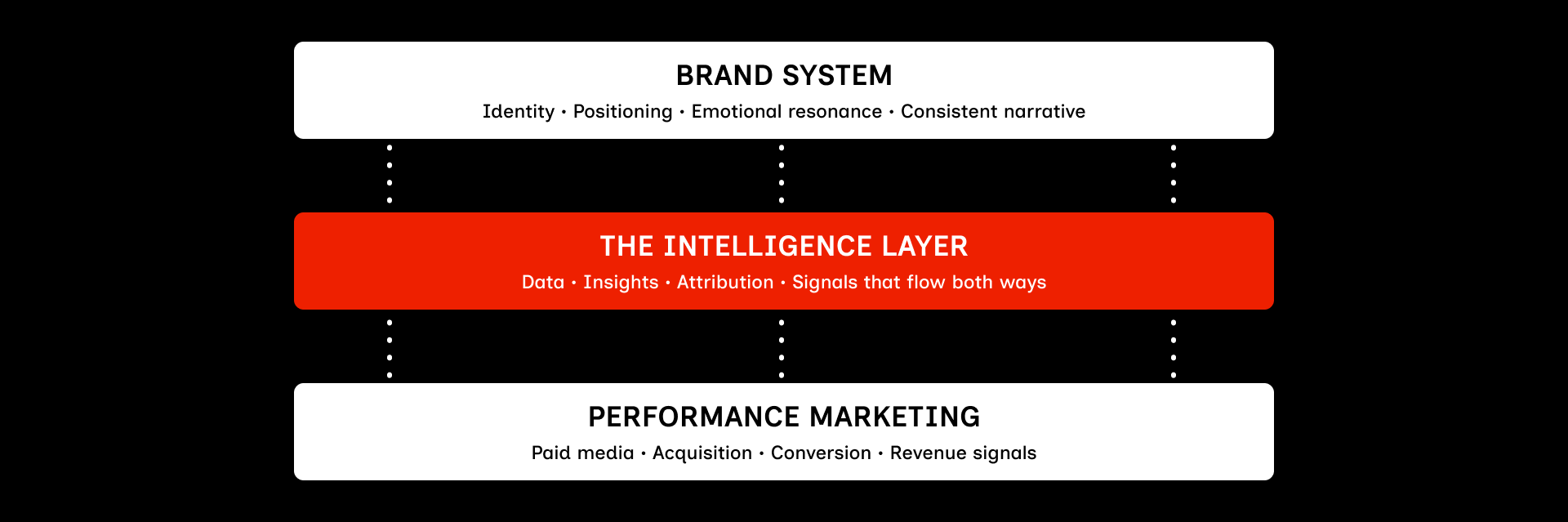
The Intelligence Layer: Where brand and performance start talking
Performance data tells the brand team what’s resonating: which messages land, which audiences convert, which emotional territory drives action.
Brand strategy tells the performance team what to amplify: which narrative threads are gaining traction, what positioning is building equity that converts later.
When this layer works, brand and performance stop being a turf war and start functioning as a system. The data doesn’t just measure the past — it shapes what you do next.
Intelligence isn’t a dashboard. It’s the infrastructure that makes the whole system learn.
Five questions worth asking yourself
Before any growth conversation, I run clients through these. The answers are usually more revealing than any audit.
Can you trace a clear line from your brand positioning to your best-performing acquisition channel?
Do your performance signals inform your brand decisions — or do they live in separate reports?
Which stage of the growth loop is your actual bottleneck right now?
When a customer advocates for you, do you know what triggered it?
If you doubled your performance budget tomorrow, would your brand be strong enough to make that spend more efficient — or would you just be buying more of what you already have?
The answers usually point to the same place: the gap between brand and performance isn’t a creative problem or a media problem. It’s a systems problem.
The point
The Intelligence Layer isn’t a technology solution. It’s an organisational philosophy — a commitment to building marketing that learns from itself, where every conversion makes the brand smarter and every brand investment makes conversions cheaper.
Stop choosing between brand and performance. Build the layer that connects them.
That’s not a nice-to-have. That’s the growth model.
Pat is the founder of Rebellion Consulting, a strategic growth consultancy operating at the intersection of brand systems and performance marketing. He is currently also the CMO of FXTrading.com, a global trading platform built to give serious traders more control, clarity and confidence when markets are at their most volatile.
